- 简体中文
- English

Why More Game Studios Are Refocusing on Casual Games
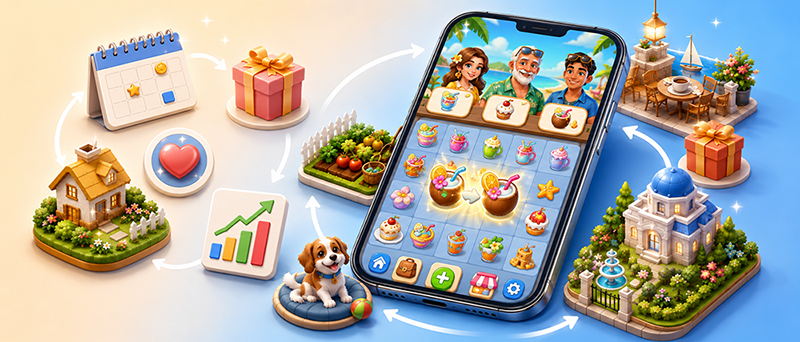
In recent years, more game studios have started to pay renewed attention to casual games.
Here, “casual games” does not simply mean small games or lightweight gameplay. From a gameplay perspective, mechanics such as Merge, Match-3, solitaire, sorting, and light puzzle gameplay continue to be explored. From a theme perspective, home design, restaurants, farms, pets, manors, travel, and lifestyle settings are also being combined with these mechanics to create new product concepts.
On the surface, it may look like game studios are moving toward lighter and more accessible products.
But more accurately, many teams are looking for a product structure that is easier to operate, repackage, and expand over the long term.
We can understand this through one concept: operational density.
Operational density means whether a game can continuously generate new goals, new content, new events, new monetization points, and new visual packaging during long-term operations.
This is one of the key reasons why casual games are gaining renewed attention. Their value does not come from being simple, but from being easier to operate continuously.
1. The Value of Casual Games Is Not Just a Broader Audience
When people talk about casual games, they often think of low entry barriers, simple controls, short-session play, and broader audience coverage.
These are important advantages of casual games.
However, if we only look at this layer, it is easy to underestimate today’s casual games.
Commercially valuable casual products no longer win only because the gameplay is easy to understand. They are more like long-running content containers.
The same core gameplay can continuously support holiday events, limited-time tasks, scene renovation, character stories, collection systems, leaderboards, gift packages, reactivation campaigns, and ad creative testing.
Players experience something light and relaxing.
Behind that experience, the project team is operating a system that continuously creates goals, rewards, and emotional feedback.
This is why casual games are not valuable simply because they are simple. They are valuable because they can more easily form a long-term operation loop.
2. Repeated Casual Themes Are Not Always a Lack of Creativity
Home design, restaurants, farms, pets, manors, and travel themes appear repeatedly in casual games.
From the outside, these directions may seem common or even familiar.
But from a long-term operation perspective, these themes are not only common. They naturally offer stronger scalability.
• Home design can support organizing, repairing, beautifying, and a sense of ownership
• Restaurant themes can support management, service, daily warmth, and growth
• Farm themes can support planting, harvesting, order, and relaxation
• Pet themes can support companionship, care, cuteness, and responsibility
• Manor themes can support space, collection, renovation, and long-term goals
• Travel themes can support exploration, memories, and different lifestyle fantasies
These themes continue to appear because they can provide stable emotional rewards.
Players are not only completing levels. They are also receiving feedback such as “I made something better,” “I own this space,” “I took care of this character,” or “I completed a small goal.”
This kind of emotional feedback is highly suitable for long-term operations.
Therefore, theme selection should not only focus on whether an idea feels new. It should also consider whether the theme can continuously generate content, events, scenes, and advertising expressions.
3. Casual Game Content May Be Lightweight, But It Must Be Reconfigurable
Compared with some mid-core or hardcore products, individual content units in casual games are often smaller.
For example, a new Merge item chain, a new scene area, a set of holiday decorations, a character event, or a new event entrance can all become part of a version update.
These content pieces may not look heavy on their own, but they can be recombined in many ways.
• A holiday theme can be used for the board, pop-ups, gift packages, ad creatives, and social media content
• A scene renovation can drive task goals, story progression, and reward feedback
• A set of decorative assets can become a collection event, paid bundle, or long-term goal
• A character event can extend into story content, expressions, illustrations, and ad hooks
This is an important characteristic of casual games: smaller content units, but greater reuse potential.
Valuable content is not only about whether it looks good. It is also about whether it can be reused, repackaged, and converted repeatedly.
This is why many teams pay more attention to art production rhythm and content pipelines once a product enters the operation stage.
4. Casual Game Art Is Not as Simple as It Looks
Some people may think casual game art is relatively easy, as long as it looks cute, bright, and attractive.
In real production, however, casual game art often requires very detailed judgment.
• Board icons need to remain clear at small sizes
• Upgrade chains must show progress at a glance
• Scene renovation needs clear before-and-after contrast
• Event entrances must be visually noticeable
• Gift packages need strong visual appeal
• UI pop-ups must communicate value clearly
• Ad creatives need to express emotional conflict and satisfying moments quickly
• Characters and environments must support long-term updates, not just one-time showcase images
This means casual game art is not just packaging.
It is more like visual fuel for long-term game operations.
Whether a casual game can continuously give players a sense of freshness depends heavily on whether the team can produce clear, consistent, emotional, and conversion-oriented visual content over time.
This is also why many casual game teams need stable external art production support once their games enter the operation stage.
It is not because internal teams are not important. It is because long-term operations naturally create continuous visual production needs.
5. Casual Games Are Not Becoming Lighter. They Are Becoming More Operable.
Today, casual games should not be understood only as lightweight gameplay.
More accurately, they are product structures that are highly suitable for long-term operations.
Their advantages include low user comprehension cost, broad theme appeal, content that can be broken down easily, events that can be updated continuously, direct ad communication, scalable visual assets, and operation rhythms that can extend the product lifecycle.
Therefore, the renewed focus on casual games does not mean these games are easier to build.
On the contrary, today’s casual games are becoming more systematic.
They require teams to understand users, gameplay, themes, content rhythm, monetization, and visual production at the same time.
Players may feel that the experience is light.
But behind the product, the real competition is about who can continuously provide new goals, new emotions, and new visual content.
Conclusion
Casual games may look light, but they are not simple to build well.
Behind them are user understanding, theme judgment, content rhythm, visual standards, and long-term production capability.
These questions do not always have standard answers, but they appear repeatedly throughout real project production.
For art teams that support casual games over the long term, the key is not only to complete individual assets. It is also to understand what the game needs at each stage: visual exploration and direction validation in the early stage, stable visual standards during production, and continuous, consistent, scalable art content during long-term operations.
In the future, casual game competition will not only be about gameplay. It will also be about theme scalability, content production capability, and visual operation capability.
The teams that can continuously provide new goals, new emotions, and new visual content will have a better chance of keeping their products alive over the long term.
About UOWLS
UOWLS is a game art outsourcing studio supporting casual and mobile game teams with character art, environment art, props, illustrations, UI, icons, Spine animation, promotional video visuals, 3D characters, and 3D environments.
We support teams across different production stages, from early visual exploration and small-scale art tests to full production and ongoing content updates after launch.
Our experience covers Merge games, Match-3 games, simulation games, dress-up games, cooking games, Bingo games, casual SLG projects, life simulation games, and other stylized casual mobile games.
UOWLS has supported multiple mature live game projects, gaining practical experience in style consistency, scalable production, and long-term art content updates for casual and mobile game teams.

```
Why More Game Studios Are Refocusing on Casual Games
In recent years, more game studios have started to pay renewed attention to casual games.
Here, “casual games” does not simply mean small games or lightweight gameplay. From a gameplay perspective, mechanics such as Merge, Match-3, solitaire, sorting, and light puzzle gameplay continue to be explored. From a theme perspective, home design, restaurants, farms, pets, manors, travel, and lifestyle settings are also being combined with these mechanics to create new product concepts.
On the surface, it may look like game studios are moving toward lighter and more accessible products.
But more accurately, many teams are looking for a product structure that is easier to operate, repackage, and expand over the long term.
We can understand this through one concept: operational density.
Operational density means whether a game can continuously generate new goals, new content, new events, new monetization points, and new visual packaging during long-term operations.
This is one of the key reasons why casual games are gaining renewed attention. Their value does not come from being simple, but from being easier to operate continuously.
1. The Value of Casual Games Is Not Just a Broader Audience
When people talk about casual games, they often think of low entry barriers, simple controls, short-session play, and broader audience coverage.
These are important advantages of casual games.
However, if we only look at this layer, it is easy to underestimate today’s casual games.
Commercially valuable casual products no longer win only because the gameplay is easy to understand. They are more like long-running content containers.
The same core gameplay can continuously support holiday events, limited-time tasks, scene renovation, character stories, collection systems, leaderboards, gift packages, reactivation campaigns, and ad creative testing.
Players experience something light and relaxing.
Behind that experience, the project team is operating a system that continuously creates goals, rewards, and emotional feedback.
This is why casual games are not valuable simply because they are simple. They are valuable because they can more easily form a long-term operation loop.
2. Repeated Casual Themes Are Not Always a Lack of Creativity
Home design, restaurants, farms, pets, manors, and travel themes appear repeatedly in casual games.
From the outside, these directions may seem common or even familiar.
But from a long-term operation perspective, these themes are not only common. They naturally offer stronger scalability.
• Home design can support organizing, repairing, beautifying, and a sense of ownership
• Restaurant themes can support management, service, daily warmth, and growth
• Farm themes can support planting, harvesting, order, and relaxation
• Pet themes can support companionship, care, cuteness, and responsibility
• Manor themes can support space, collection, renovation, and long-term goals
• Travel themes can support exploration, memories, and different lifestyle fantasies
These themes continue to appear because they can provide stable emotional rewards.
Players are not only completing levels. They are also receiving feedback such as “I made something better,” “I own this space,” “I took care of this character,” or “I completed a small goal.”
This kind of emotional feedback is highly suitable for long-term operations.
Therefore, theme selection should not only focus on whether an idea feels new. It should also consider whether the theme can continuously generate content, events, scenes, and advertising expressions.
3. Casual Game Content May Be Lightweight, But It Must Be Reconfigurable
Compared with some mid-core or hardcore products, individual content units in casual games are often smaller.
For example, a new Merge item chain, a new scene area, a set of holiday decorations, a character event, or a new event entrance can all become part of a version update.
These content pieces may not look heavy on their own, but they can be recombined in many ways.
• A holiday theme can be used for the board, pop-ups, gift packages, ad creatives, and social media content
• A scene renovation can drive task goals, story progression, and reward feedback
• A set of decorative assets can become a collection event, paid bundle, or long-term goal
• A character event can extend into story content, expressions, illustrations, and ad hooks
This is an important characteristic of casual games: smaller content units, but greater reuse potential.
Valuable content is not only about whether it looks good. It is also about whether it can be reused, repackaged, and converted repeatedly.
This is why many teams pay more attention to art production rhythm and content pipelines once a product enters the operation stage.
4. Casual Game Art Is Not as Simple as It Looks
Some people may think casual game art is relatively easy, as long as it looks cute, bright, and attractive.
In real production, however, casual game art often requires very detailed judgment.
• Board icons need to remain clear at small sizes
• Upgrade chains must show progress at a glance
• Scene renovation needs clear before-and-after contrast
• Event entrances must be visually noticeable
• Gift packages need strong visual appeal
• UI pop-ups must communicate value clearly
• Ad creatives need to express emotional conflict and satisfying moments quickly
• Characters and environments must support long-term updates, not just one-time showcase images
This means casual game art is not just packaging.
It is more like visual fuel for long-term game operations.
Whether a casual game can continuously give players a sense of freshness depends heavily on whether the team can produce clear, consistent, emotional, and conversion-oriented visual content over time.
This is also why many casual game teams need stable external art production support once their games enter the operation stage.
It is not because internal teams are not important. It is because long-term operations naturally create continuous visual production needs.
5. Casual Games Are Not Becoming Lighter. They Are Becoming More Operable.
Today, casual games should not be understood only as lightweight gameplay.
More accurately, they are product structures that are highly suitable for long-term operations.
Their advantages include low user comprehension cost, broad theme appeal, content that can be broken down easily, events that can be updated continuously, direct ad communication, scalable visual assets, and operation rhythms that can extend the product lifecycle.
Therefore, the renewed focus on casual games does not mean these games are easier to build.
On the contrary, today’s casual games are becoming more systematic.
They require teams to understand users, gameplay, themes, content rhythm, monetization, and visual production at the same time.
Players may feel that the experience is light.
But behind the product, the real competition is about who can continuously provide new goals, new emotions, and new visual content.
Conclusion
Casual games may look light, but they are not simple to build well.
Behind them are user understanding, theme judgment, content rhythm, visual standards, and long-term production capability.
These questions do not always have standard answers, but they appear repeatedly throughout real project production.
For art teams that support casual games over the long term, the key is not only to complete individual assets. It is also to understand what the game needs at each stage: visual exploration and direction validation in the early stage, stable visual standards during production, and continuous, consistent, scalable art content during long-term operations.
In the future, casual game competition will not only be about gameplay. It will also be about theme scalability, content production capability, and visual operation capability.
The teams that can continuously provide new goals, new emotions, and new visual content will have a better chance of keeping their products alive over the long term.
About UOWLS
UOWLS is a game art outsourcing studio supporting casual and mobile game teams with character art, environment art, props, illustrations, UI, icons, Spine animation, promotional video visuals, 3D characters, and 3D environments.
We support teams across different production stages, from early visual exploration and small-scale art tests to full production and ongoing content updates after launch.
Our experience covers Merge games, Match-3 games, simulation games, dress-up games, cooking games, Bingo games, casual SLG projects, life simulation games, and other stylized casual mobile games.
UOWLS has supported multiple mature live game projects, gaining practical experience in style consistency, scalable production, and long-term art content updates for casual and mobile game teams.
```